EVM++ Sidecars
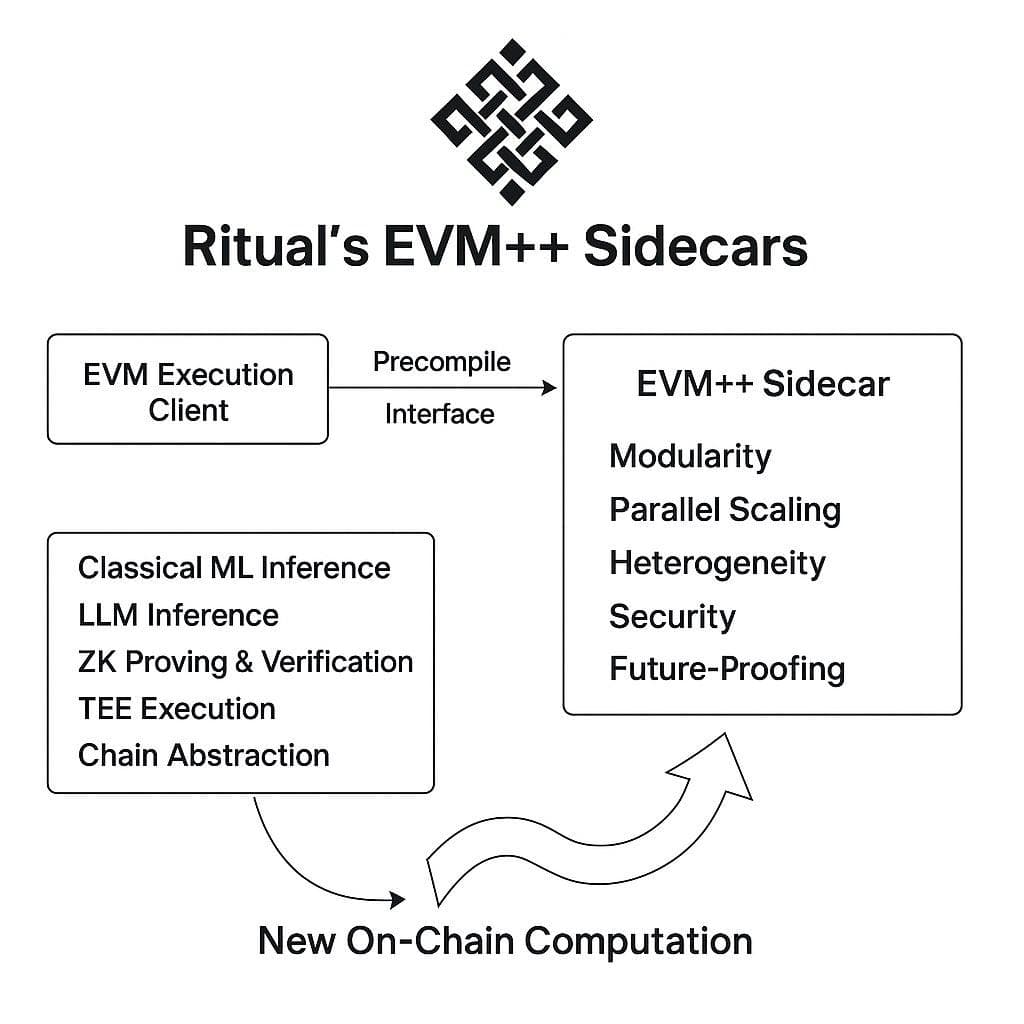
EVM++ Sidecars introduce a new execution model that decouples extensibility from the execution client, without compromising determinism or consensus safety.
Overview
In traditional EVM implementations, precompiles are hardcoded directly into the execution client. Adding new primitives requires client engineering, audits, and network-wide coordination.
EVM++ Sidecars break this bottleneck by moving advanced computation into containerized execution services that run alongside the node, rather than inside the client itself.
The EVM remains minimal and consensus-safe, while execution capabilities evolve independently at software speed.
Execution Architecture
Sidecars expose their functionality to smart contracts through well-defined, typed precompile interfaces. From the developer’s perspective, these calls look like ordinary contract interactions.
- A contract invokes a sidecar-backed precompile interface
- The node routes the request to the appropriate sidecar
- The sidecar executes the workload in an isolated container
- A verifiable result is produced
- The EVM finalizes the result on-chain
The contract interacts with a typed interface rather than raw bytes, while the execution details remain fully abstracted away.
Core Properties
Modular, Permissionless Extensibility
Any containerized workload can be registered as a sidecar. Developers do not need to modify the execution client or coordinate hard forks.
Once registered, the sidecar becomes a native precompile callable from smart contracts using stable, typed interfaces.
Horizontal Compute Scaling
Sidecars scale independently of block execution. Increasing demand for AI inference or ZK proving increases sidecar capacity, not validator load.
- Inference throughput scales with dedicated inference nodes
- ZK proving scales with specialized prover infrastructure
- Block production remains lightweight and predictable
Heterogeneous Execution
Sidecars are free to use the hardware and execution environment best suited to their workload.
- GPUs for large-scale inference
- Specialized hardware for ZK proving
- Trusted Execution Environments for privacy-sensitive logic
- Cross-chain adapters for external state access
Security Through Separation
Consensus-critical code remains minimal and auditable. Advanced compute runs in isolated execution environments with explicit verification boundaries.
This separation reduces systemic risk while still enabling expressive, compute-heavy applications.
Shipped EVM++ Sidecars
- Classical ML inference (ONNX-based models)
- LLM inference (sovereign, verifiable execution)
- Zero-knowledge proving and verification
- TEE-backed execution with attestation
- Chain abstraction and cross-chain reads
Why Sidecars Matter
EVM++ Sidecars transform the EVM from a closed execution engine into a modular, extensible execution substrate.
Anything that can run in a container can become a native precompile, without forks, without client bloat, and without sacrificing decentralization.