EVM++
EVM++ is a backwards-compatible extension of the Ethereum Virtual Machine designed to make smart contracts actually smart.
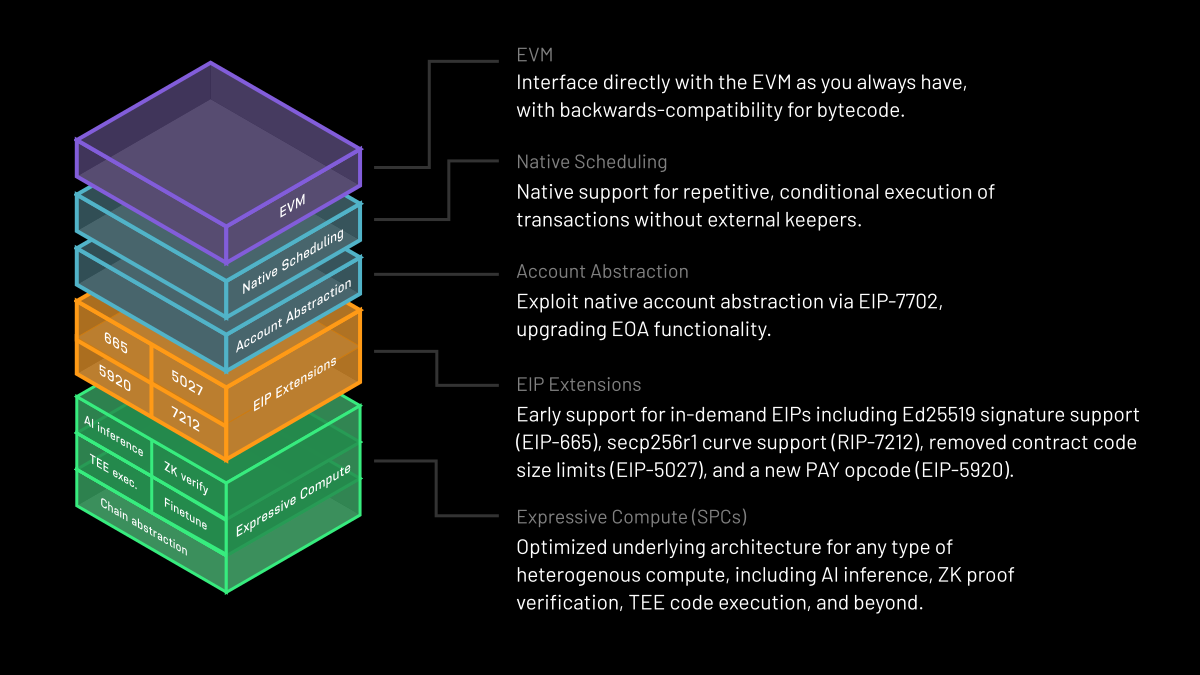
Overview
The original EVM was designed around a simple assumption: all computation must be synchronous, lightweight, and complete within a single transaction. While this made Ethereum viable, it fundamentally limited what smart contracts could do.
EVM++ removes these limitations while preserving full EVM compatibility. Existing contracts, tooling, and developer workflows continue to work unchanged, while developers can progressively opt into new capabilities.
EVM++ introduces expressive compute precompiles, native scheduling, built-in account abstraction via EIP-7702, and early support for the most impactful EIPs — all without changing Solidity or the EVM execution model developers already understand.
Core Components
- Scheduled Transactions — recurring and conditional execution guaranteed by the protocol itself, without external keepers or bots.
- Account Abstraction — programmable EOAs via EIP-7702, without deploying new wallets or changing addresses.
- EIP Extensions — native support for Ed25519 (665), secp256r1 (7212), unlimited code size (5027), PAY opcode (5920), and more.
- Expressive Compute — AI inference, ZK proofs, TEE execution, fine-tuning, and cross-chain compute via native precompiles.
Expressive Compute Precompiles
Expressive Compute Precompiles expose advanced computation directly inside the EVM as native system calls. Instead of relying on external APIs, centralized inference servers, or custom coprocessors, EVM++ enshrines these operations at the VM level.
From a smart contract’s perspective, calling an AI model or verifying a ZK proof looks like calling any other precompile.
The heavy computation happens off the critical execution path, while the EVM verifies results deterministically.
Native Scheduling
Native Scheduling is a first-class automation layer built directly into EVM++. Contracts can schedule execution at the protocol level, without relying on off-chain cron jobs, bots, or keepers.
Execution occurs at the top of the block and is guaranteed by consensus, making automation deterministic and censorship-resistant.
// Example: scheduling a conditional execution

Scheduler.schedule({
    when: block.timestamp + 1 days,
    condition: price < threshold,
    callback: address(this),
    data: abi.encode("rebalance")
});
Account Abstraction (EIP-7702)
EIP-7702 allows EOAs to delegate smart contract logic to themselves without deploying new wallets or changing addresses.
This removes the biggest UX bottleneck in Ethereum: the split between “simple” EOAs and “powerful” contract wallets.
- One-transaction batching
- Native gas sponsorship
- Scoped permissions for agents
- Upgradeable EOA behavior
Why EVM++ Matters
EVM++ is not a patch or a compatibility layer. It is a redesigned execution environment that turns smart contracts into long-lived, autonomous, and compute-aware programs.
This is the execution layer required for AI-native applications, autonomous agents, verifiable computation, and the next generation of on-chain systems.